
You can clear some gutters from the ground with a long-reach tool, without climbing onto the roof. The risks of climbing on a roof to clean gutters include falling and damaging shingles, so staying on the ground makes sense when the debris is within reach. Ground-based tools have limits: they may not clear every blockage or let you inspect the gutters and downspouts closely.
It’s reasonable to look for a safer way to keep leaves and debris from restricting water flow, especially with the rain and downpours common across Maple Ridge, Pitt Meadows, Coquitlam, Port Moody, Langley, Surrey, Mission and Abbotsford. This guide covers how to clean gutters from the ground, what to watch for, and when their height or condition makes DIY cleaning unsuitable.
You’ll also learn why roof access adds risk, how to spot the limits of ground-based tools, and what thorough gutter cleaning should address. The goal is practical: maintain clear drainage without taking unnecessary risks on a roof.
Key Takeaways
- Use a long-reach tool from the ground when debris is accessible, but recognize that it may not clear every blockage or allow a close inspection.
- Postpone gutter work in rain, frost or ice, strong winds, or when lightning is possible.
- Keep well clear of overhead wires and watch for pests or nests before approaching gutters.
- If a ladder is necessary, set it securely, maintain three points of contact, and move it rather than reaching sideways.
Professional gutter-cleaning safety and inspections
Hire a professional for homes with two or more storeys or gutters that are difficult to reach safely. Postpone outdoor work during rain, frost or ice, strong winds, or possible lightning.
Decide whether to hire a professional
- Assess the height and access before starting. A professional is the safer choice for homes with two or more storeys, steep rooflines, or gutters that cannot be reached from stable ground. Also stop if the work would require walking on shingles. Foot traffic can crack shingles and remove their protective granules. In Maple Ridge’s wet spring conditions, slippery surfaces add another reason to avoid roof access.
Inspect ladders and cleaning equipment
- Check every ladder component before use. Look for damaged rails, loose steps, worn feet, and parts that fail to lock securely. Inspect the scoop, bucket, and any extension pole for cracks or loose fittings. Wet leaves and packed debris can add weight quickly, so empty a bucket often. Don’t use damaged equipment or rely on a tool that shifts while extended.
Select the right ladder
- Choose a ladder that reaches the work without standing on its top two rungs. For gutter access, an extension ladder should extend at least three feet above the gutter line. Set its base one foot from the wall for every four feet of ladder height. Keep the ladder on firm, level ground, and use a stabilizer or standoff rather than resting it against the gutter.
Set up and work with care
- Ask someone to stay nearby while you work. Keep three points of contact on the ladder, and move it whenever the next section requires sideways reaching. Avoid cleaning alone, especially when carrying tools or wet debris. Professionals can also flush downspouts and inspect gutters for damage, checks that are difficult to complete thoroughly while balancing on a ladder.
Electrical wires and pests in gutters
Before starting, scan the gutter line for overhead wires, nests, and wildlife activity. Leaves and damp debris can hide hazards, so keep a safe distance if you spot any.
- Look for overhead wires from the ground. Trace their path near the roofline and downspouts before positioning a ladder or extension tool. If wires pass near the work area, don’t proceed from that spot. A long pole can bring you closer to wires than expected, even when your feet stay on the ground.
- Keep the required distance from wires. Stay at least three metres away from overhead wires while cleaning gutters. Treat the ladder, pole, and any tool you carry as part of your reach. If you can’t maintain that clearance, stop and choose a safer approach rather than stretching around the obstacle.
- Never touch a wire or cable. Don’t assume a line is harmless because it looks insulated, low, or disconnected. Keep tools and debris away from it. If a wire appears loose or damaged beside the gutter, leave the area undisturbed and don’t attempt to move it.
- Check for pest activity before removing debris. Look for nests, repeated bird activity, droppings, or insects entering a gap beneath the roof edge. Don’t put your hand into a blocked section to investigate. Leaves can hide a nest or pest activity, so inspect visible areas before using a scoop or pole.
- Stop if you find a nest or active pests. Avoid shaking the gutter, spraying into a nest, or trying to remove it while balanced on a ladder. Sudden movement can cause a fall or bring you into contact with wildlife or stinging insects. Keep people and pets away from the immediate area.
- Choose a safer next step when hazards overlap. Overhead wires, hidden nests, and packed leaves can make access difficult at the same time. If these conditions prevent safe cleaning, arrange professional gutter cleaning rather than reaching into the gutter yourself.
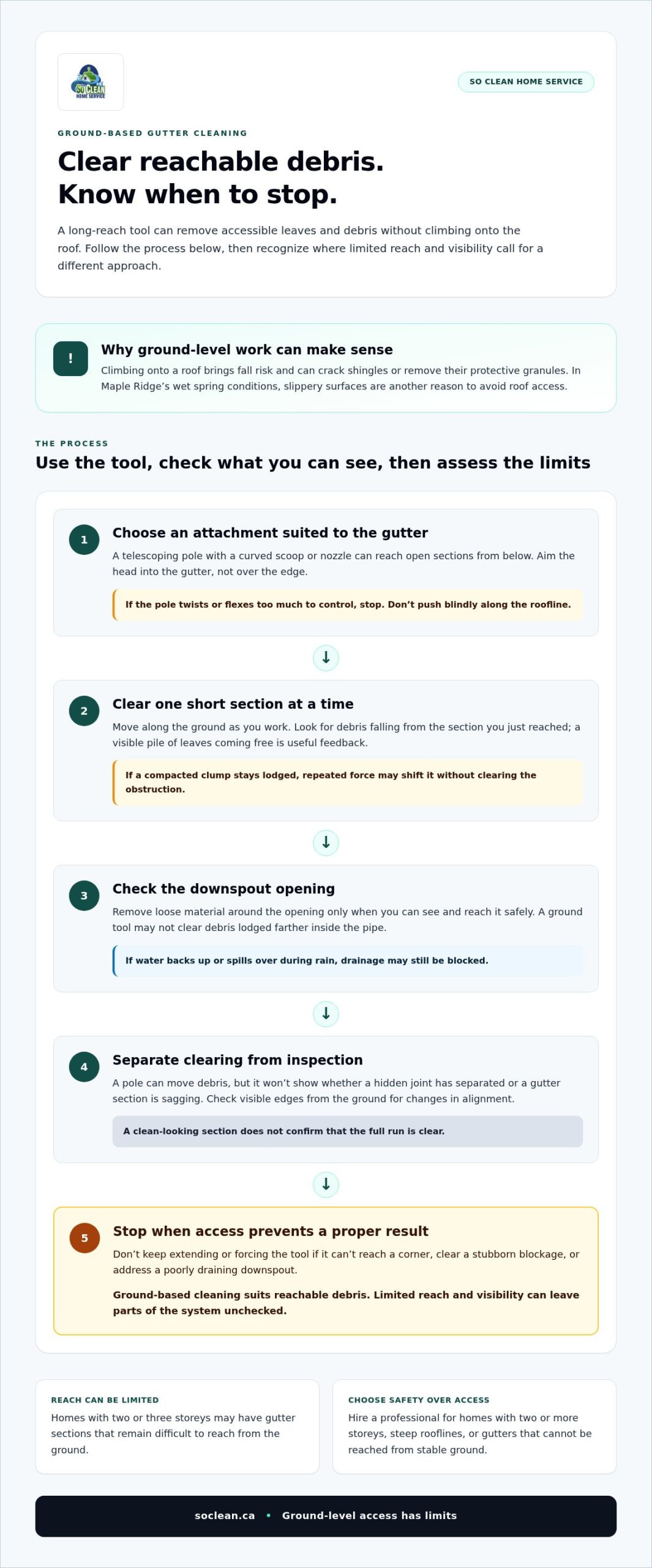
Ground-based cleaning tools and their limitations
Ground-based tools can remove accessible gutter debris without roof access. In Maple Ridge, homes with two or three storeys may have sections that remain difficult to reach from the ground. Stop if the tool cannot clear the gutters effectively.
- Pick an attachment suited to the gutter. A telescoping pole with a curved scoop or nozzle can reach open sections from below. Check that its head points into the gutter, not over the edge. If the pole twists or flexes too much to control, stop rather than pushing blindly along the roofline.
- Clear a short section at a time. Move along the ground as you work, and look for debris falling from the section you’ve just reached. A visible pile of leaves coming free is useful feedback. If a compacted clump stays lodged, repeated force may shift it without clearing the obstruction.
- Watch the downspout opening. Remove loose material around the opening only when you can see and reach it safely. A ground tool may not clear debris lodged farther inside the pipe. If water backs up or spills over during rain, drainage may still be blocked.
- Separate clearing from inspection. A pole can move debris, but it won’t show whether a hidden joint has separated or a gutter section is sagging. Check visible edges from the ground for changes in alignment. Don’t assume a clean-looking section means the full run is clear.
- Stop when access prevents a proper result. If the tool can’t reach a corner, clear a stubborn blockage, or address a poorly draining downspout, don’t keep extending or forcing it. Ground-based cleaning is useful for reachable debris, but limited reach and visibility can leave parts of the system unchecked.
What ladder safety steps reduce the risk of falling while cleaning gutters?
- Choose a ladder that reaches the gutter line safely. An extension ladder should extend at least three feet above the gutter. This gives you a secure point to hold while stepping off. Don’t stand on the top two rungs to gain extra reach.
- Set the ladder at the correct angle. Use the 4-to-1 rule: place the base one foot from the wall for every four feet of ladder height. Check the ladder’s position before climbing, and reset it if the ground or wall makes that angle unstable.
- Protect the gutter from ladder pressure. Attach a ladder stabilizer or standoff so the rails rest against the wall, not the gutter. This can also help keep the ladder from shifting sideways. Don’t use the gutter itself as a support point.
- Keep three points of contact while climbing. Hold the ladder with both hands when ascending or descending. Carry tools in a belt or raise them separately, so your hands remain available. Start cleaning only after you’re stable and positioned to work.
- Move the ladder instead of reaching sideways. Clean the section directly in front of you, then climb down and reposition the ladder. Reaching past the side rails can shift your balance. Moving the ladder takes thirty seconds, far less time than recovering from a fall.
- Have someone stay nearby. Don’t clean gutters alone. A second person can steady the ladder and call for help if you’re injured. Ask them to keep the area clear while you move between sections.
- Stop if the setup changes. Wet ground, a shifting base, or a ladder that won’t sit firmly means the work should pause. Don’t try to correct the ladder while standing on it; climb down before adjusting the setup.
- Choose help if safe ladder access isn’t practical. If height, placement, or reach makes these steps difficult, arrange professional gutter cleaning instead of pressing ahead.
So Clean Home Service: Gutter Cleaning
So Clean Home Service provides gutter cleaning when debris is beyond the reach of ground-based tools or ladder access feels unsafe. In Maple Ridge, Pitt Meadows, Coquitlam, Port Moody, Langley, Surrey, Mission, and Abbotsford, wet weather and seasonal leaf fall can obstruct gutters. Clearing them helps water flow through the system instead of overflowing at the roof edge.
Consider professional help for a high roof, difficult access, persistent blockages, or gutters that need closer attention than a ground-level tool can provide. Keep up with routine maintenance without taking on roof work yourself. Contact So Clean Home Service to discuss gutter cleaning for your property.
Make your next gutter check a safer one
Choose a maintenance approach that suits your home’s access, roofline, and surroundings. A ground-based tool can help clear reachable debris, but don’t stretch awkwardly or attempt unsafe roof access to reach more. The risks of climbing on a roof to clean gutters are a good reason to pause when the job exceeds your reach or comfort.
For homes across Maple Ridge, Pitt Meadows, Coquitlam, Port Moody, Langley, Surrey, Mission, and Abbotsford, regular attention helps keep rainwater moving away from the roof edge and foundation. Include gutter checks in your seasonal upkeep, and treat blocked drainage or difficult access as a reason to choose a safer solution.
So Clean Home Service can help with exterior maintenance through gutter cleaning, pressure washing, and roof cleaning and moss removal. Contact So Clean Home Service to discuss gutter cleaning for your property. A considered next step can protect your safety while keeping your home’s drainage on track.
Frequently Asked Questions
Ready to Skip the Ladder?
Yes, if a ground-based tool can reach the debris without awkward stretching. A long-reach attachment may remove accessible leaves while you remain on firm ground. If the tool can’t reach a clogged corner behind a second-storey roofline, for example, don’t climb onto the roof to finish the job. Choose professional help when height or access makes the task unsafe.
What About Cleaning From the Ground?
Ground-based cleaning can clear visible, reachable debris, but it may not remove a blockage deep inside a downspout. Try a telescoping gutter tool on a short section and see whether the loosened material comes free. If water still spills over during rain or a hidden section remains out of reach, the tool hasn’t resolved the drainage problem.
What are the main risks of climbing onto a roof to clean gutters?
The risks of climbing on a roof to clean gutters include falling, slipping on wet surfaces, and damaging shingles underfoot. A fall can cause serious injury, while cracked shingles or displaced protective granules can leave the roof more exposed to weather. Carrying a bucket or tool across the roof can also affect your balance and make each step less secure.
How common are ladder and roof falls during gutter cleaning, and what are the injury statistics in Canada?
Canadian-specific gutter-cleaning injury figures should not be inferred from U.S. statistics. The American Academy of Orthopedic Surgeons reports that 500,000 people in the United States were treated for ladder-use-related injuries in 2023, and 300 ladder-use-related incidents resulted in fatalities that year. These are U.S. figures, not Canadian rates or counts for gutter cleaning.
What protective equipment is recommended for roof and gutter cleaning?
Wear footwear with secure traction, work gloves, and eye protection when handling debris. Set up the ladder securely, using a stabilizer or standoff to avoid putting pressure on the gutter. Equipment does not make roof access risk-free, and gloves or footwear cannot prevent a fall. Avoid the task if rain, frost, ice, wind, or possible lightning makes conditions unsafe.
Is it safer to clean gutters from a ladder, from the roof, or with ground-based tools?
Ground-based tools avoid climbing, making them a sensible first choice when they can reach the debris. A properly positioned ladder can provide access, but still carries a fall risk. Walking on the roof adds fall exposure and can damage shingles. Match the method to the access: use ground tools for reachable sections, and don’t force ladder or roof access.